
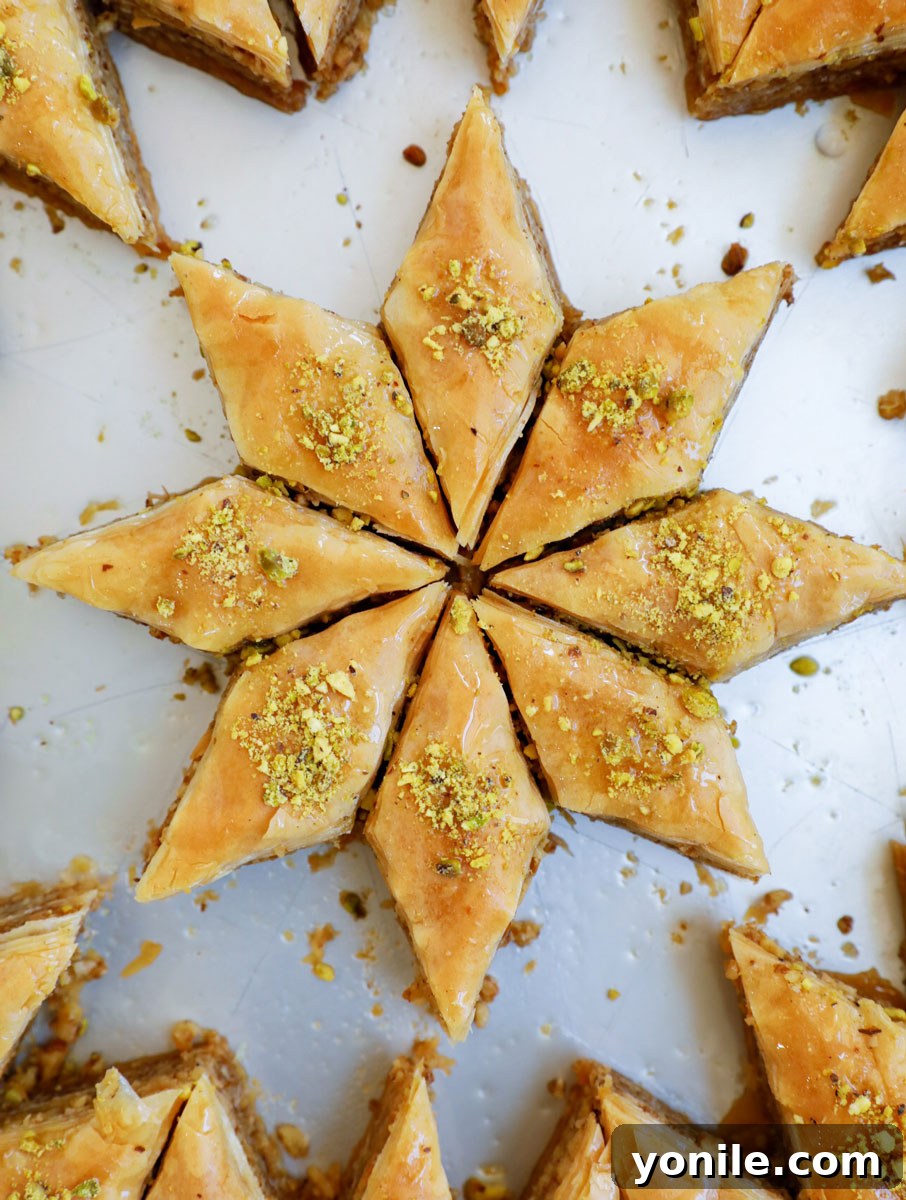
Indulge in the exquisite pleasure of homemade Walnut Baklava, a magnificent dessert crafted with devotion and layered to perfection. This timeless treat features dozens of gossamer-thin sheets of flaky phyllo dough, generously filled with three distinct layers of finely ground walnuts, then showered with a fragrant, aromatic simple syrup. Each bite promises a symphony of textures and flavors, from the crisp layers to the tender, nutty core, all bathed in sweet, perfumed syrup. It’s a culinary masterpiece that is truly impossible to resist, a testament to the fact that some creations demand patience and passion.
Just as the adage goes, you truly reap what you sow, especially when it comes to crafting truly extraordinary desserts. When aiming for an absolutely amazing taste experience, there’s simply no room for shortcuts. This homemade baklava recipe embodies that philosophy, meticulously designed to be the best you will ever create. The consistent feedback from everyone who tastes it echoes the sentiment: “It’s undeniably superior to anything store-bought.” This is more than just a recipe; it’s your foolproof guide to baking baklava that consistently impresses and delights.
Crafting your own simple syrup from scratch for this baklava recipe often means you’ll have a delightful amount left over. This presents a wonderful opportunity to explore more exquisite Lebanese dessert recipes that elegantly incorporate this fragrant syrup. Here are some beloved family favorites that you might enjoy preparing with your extra simple syrup:
- Lebanese Shaabiyat Dessert: Flaky phyllo pastries filled with clotted cream and drenched in syrup.
- Lebanese Nights Dessert: A creamy, semolina-based pudding often garnished with pistachios and syrup.
- Pistachio Baklava Recipe: A vibrant green variation of baklava, rich with finely ground pistachios.
- Fried Lebanese Atayef: Delicious stuffed pancakes, typically fried or baked, and finished with syrup.
What is Baklava? Unraveling the Layers of a Global Sweet
Baklava is an iconic, rich, and sweet layered pastry dessert. At its core, it’s traditionally prepared using phyllo pastry sheets, which are meticulously layered and filled with chopped nuts—most commonly walnuts or pistachios—and then generously sweetened with syrup or honey. However, due to its deep and extensive history, spanning across centuries and continents, the concept of “traditional” baklava can vary significantly with regional interpretations and unique local twists.
This remarkable pastry transcends mere dessert; it is a symbol of hospitality, celebration, and culinary heritage in numerous cultures. The delicate crunch of the phyllo, the robust flavor of the nuts, and the fragrant sweetness of the syrup combine to create an experience that is both sophisticated and deeply comforting. While its basic components remain consistent, the nuances in nut choices, spice blends, syrup infusions, and cutting patterns offer a diverse array of baklava styles, each telling a story of its origin.
The Enduring Mystery: Where Did Baklava Originate?
The exact origins of baklava are shrouded in the mists of time, largely predating detailed historical documentation, particularly from the pre-Ottoman era. This makes pinpointing a single country of origin incredibly challenging, as evidence suggests its roots extend far and wide, influencing and being influenced by various ancient civilizations.
Many culinary historians trace its lineage back as far as the 2nd century BC, where an Ancient Roman placenta cake – a rich, layered pastry with honey and nuts – bears a striking resemblance to early forms of baklava. This suggests a long evolution rather than a singular invention. The dessert, or variations of it, has deep historical connections to, but is not limited to, modern-day Turkey, Greece, Iran, Lebanon, and Armenia. Each region has contributed its own unique twist to this beloved pastry over time, making it truly difficult to attribute its genesis to a single nation.
The Ottoman Empire is widely credited with perfecting and popularizing baklava, transforming it into the delicate, multi-layered confection we recognize today. From the opulent kitchens of the Topkapi Palace, baklava spread throughout the empire, adapting to local tastes and available ingredients. This dissemination led to the diverse styles of baklava we see across the Balkans, the Middle East, and North Africa.
In this particular Lebanese version, the distinctive twist lies in the application of Lebanese Simple Syrup (Ater). This is no ordinary sugar syrup; it is exquisitely infused with the delicate essences of rose water and orange blossom water. This aromatic infusion bestows upon the baklava a uniquely fragrant, floral note that elevates its flavor profile, making it distinctively Lebanese and profoundly captivating.

Why This Homemade Walnut Baklava Will Become Your Signature Dessert
Preparing baklava might seem like a daunting task, but this recipe is designed to simplify the process while delivering truly exceptional results. Here’s why you’ll fall in love with making this easy baklava:
- It’s an absolute showstopper. There’s no denying the sheer elegance and visual appeal of this walnut baklava. Its golden-brown, glistening layers and intricate cuts make it an impressive centerpiece for any gathering. Pulling this out of the oven guarantees gasps of delight and ensures you’ll completely wow your friends and family with your culinary prowess. It’s not just a dessert; it’s an experience.
- Surprisingly “easy” to master. While baklava traditionally has a reputation for being incredibly complicated due to its numerous steps, don’t let that deter you! This recipe breaks down the process into manageable, easy-to-follow instructions. Much of the effort simply involves patiently layering the delicate phyllo dough. Once you get into the rhythm, you’ll find it incredibly meditative and rewarding, proving that sophisticated results don’t always require overly complex techniques.
- Unforgettably delicious and superior to store-bought. The taste of freshly baked, homemade baklava is in a league of its own. The contrast between the crisp, buttery phyllo and the tender, aromatic walnut filling, all infused with fragrant simple syrup, creates a flavor profile that store-bought versions simply cannot replicate. The proof is in the pudding – or rather, in the empty tray! There are rarely any leftovers when I serve this, a clear indication of its irresistible deliciousness.
- A delightful aroma fills your home. As this baklava bakes, your kitchen will be enveloped in the most enchanting aroma of toasted walnuts, sweet spices, and fragrant syrup. It’s an olfactory experience that is almost as satisfying as tasting the finished product and builds anticipation beautifully.
- Perfect for any occasion. Whether you’re hosting a holiday feast, a family gathering, or simply want to treat yourself to something special, baklava is a versatile dessert that fits any event. Its rich flavor and elegant presentation make it ideal for celebrations, yet its comforting qualities make it a perfect indulgence for a quiet evening.
Essential Ingredients for Your Perfect Walnut Baklava
Creating magnificent baklava begins with a selection of high-quality ingredients. Here’s what you’ll need to assemble for this delectable walnut baklava recipe:
- Phyllo Dough Sheets: These ultra-thin sheets are the backbone of baklava, providing its signature flakiness. You’ll typically find them in the frozen pastry section of your local grocery store. Be sure to follow thawing instructions carefully before use.
- Ghee (Clarified Butter): Ghee imparts a rich, nutty flavor and a superior crispness to the phyllo layers that regular butter cannot match due to its lower moisture content. While you can purchase grass-fed ghee from most stores, making Homemade Ghee is a rewarding process that ensures purity and incredible flavor.
- Simple Syrup (Ater): The sweet elixir that infuses the baklava with moisture and flavor. You can learn how to make an authentic Middle Eastern Simple Syrup at home, which often includes fragrant rose water and orange blossom water for an extra layer of aromatic complexity.
- Ground Pistachios: While this is a walnut baklava, a small amount of finely ground pistachios is traditionally used for garnishing, adding a beautiful splash of vibrant green color and a delicate contrasting flavor to the finished dessert.
- Whole Walnuts: The star of the filling! Opt for fresh, high-quality whole walnuts, readily available at any grocery store. Their rich, earthy flavor is essential for the baklava’s distinctive taste.
- Powdered Sugar (Confectioners’ Sugar): This fine sugar is blended with the walnuts to create a slightly sweet and cohesive filling. Its delicate texture ensures it mixes smoothly without adding grittiness.
Step-by-Step Guide to Crafting Homemade Walnut Baklava
Embark on the journey of creating this classic dessert with confidence. Follow these steps for an unforgettable homemade baklava experience:
- Preparation is Key: Begin by preheating your oven to 350°F (175°C). This ensures your oven is at the correct temperature when you’re ready to bake.
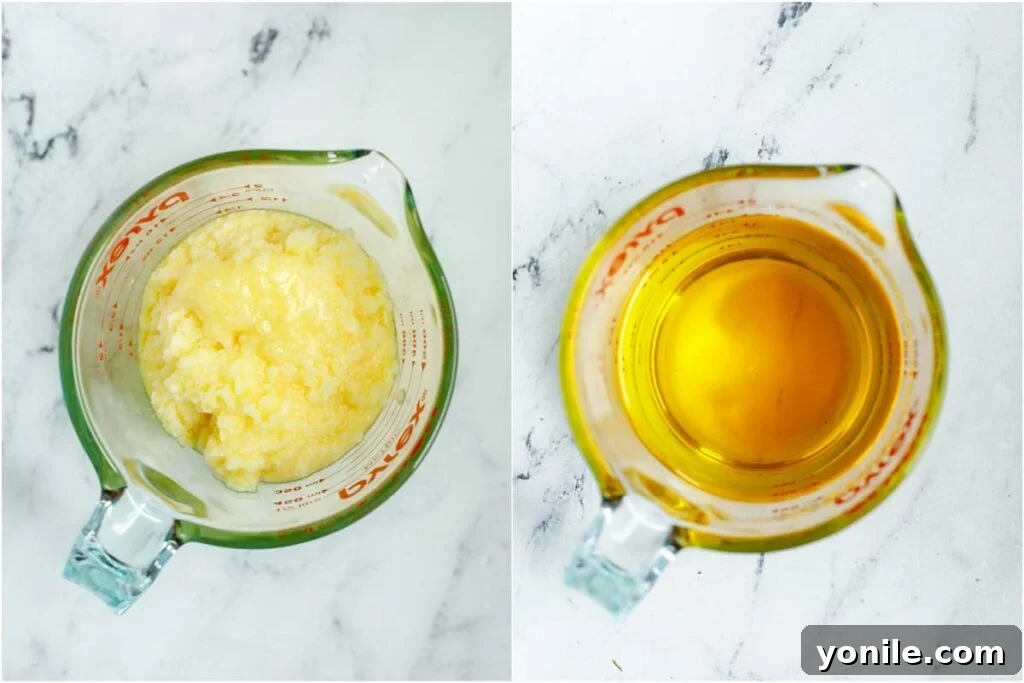
- Craft the Syrup: It is crucial to prepare your simple syrup first and allow it ample time to cool completely. Warm syrup will not be properly absorbed by the hot baklava, leading to a less desirable texture. Simultaneously, ensure your ghee is fully melted and ready for brushing.
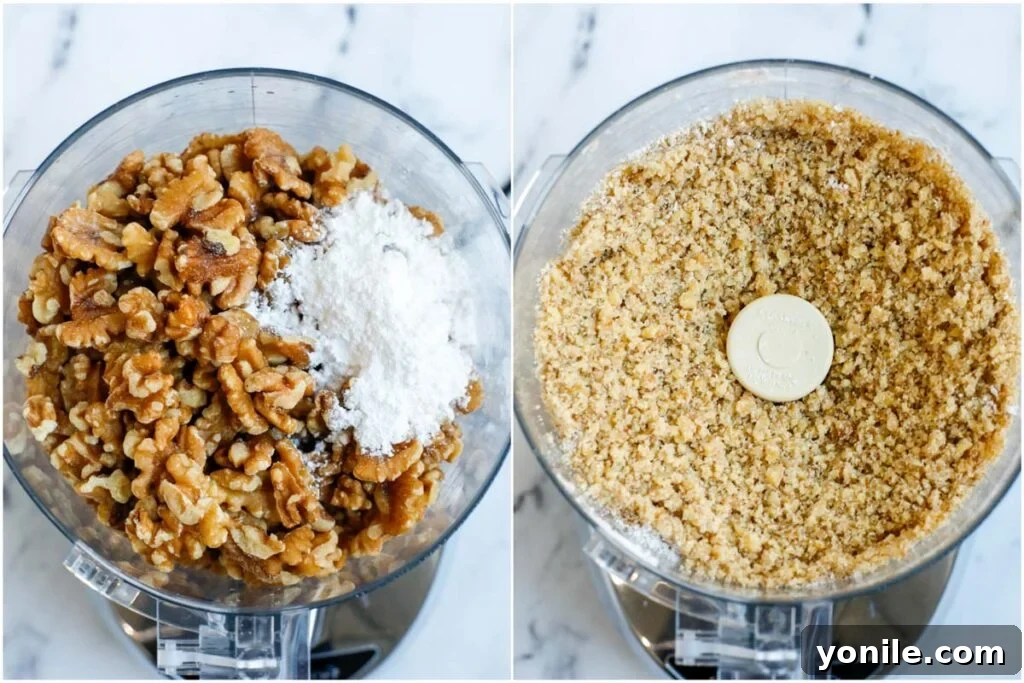
- Prepare the Walnut Filling: In a food processor, combine the whole walnuts with the powdered sugar. Pulse until the walnuts are finely ground but not oily – you want a coarse, crumbly mixture. Transfer this aromatic filling to a bowl and set it aside.
- Ready the Phyllo Sheets: Carefully unfold the delicate phyllo sheets onto a large, clean cutting board. Gently smooth them out to flatten and align them evenly.
Note: If you are using smaller phyllo sheets that perfectly fit your baking pan, you can skip the cutting step. However, if your sheets are larger, place your baking pan on top of the phyllo stack as a guide. Using a sharp knife, carefully cut the stack of phyllo sheets to precisely fit the dimensions of your pan. Repeat this process for the second pack of phyllo sheets. Remember to keep the phyllo covered with a damp towel while you work to prevent it from drying out.
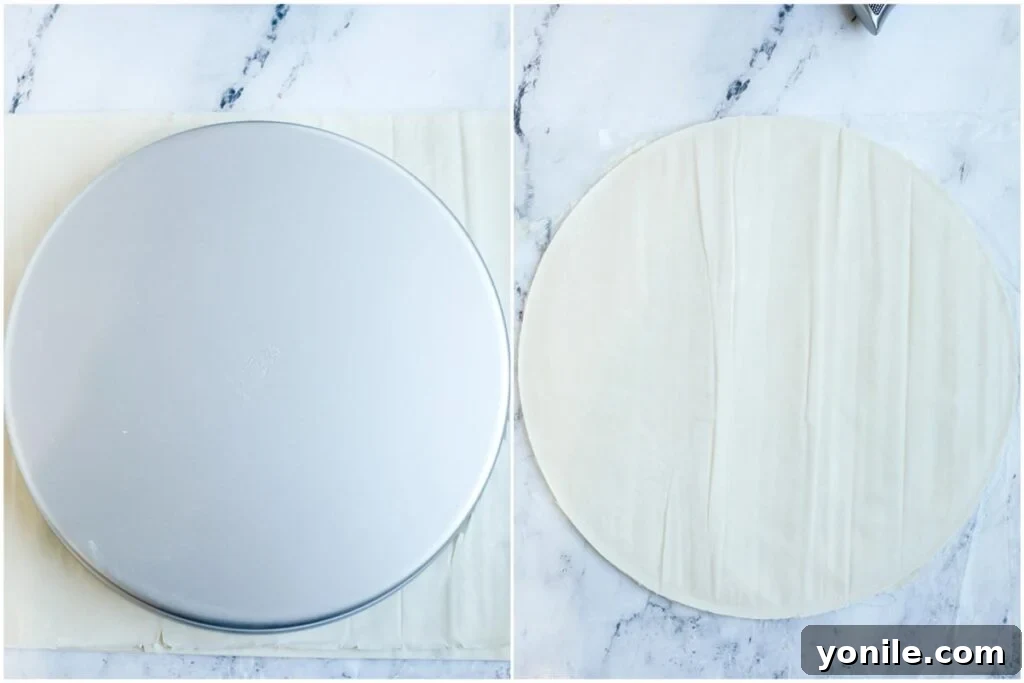
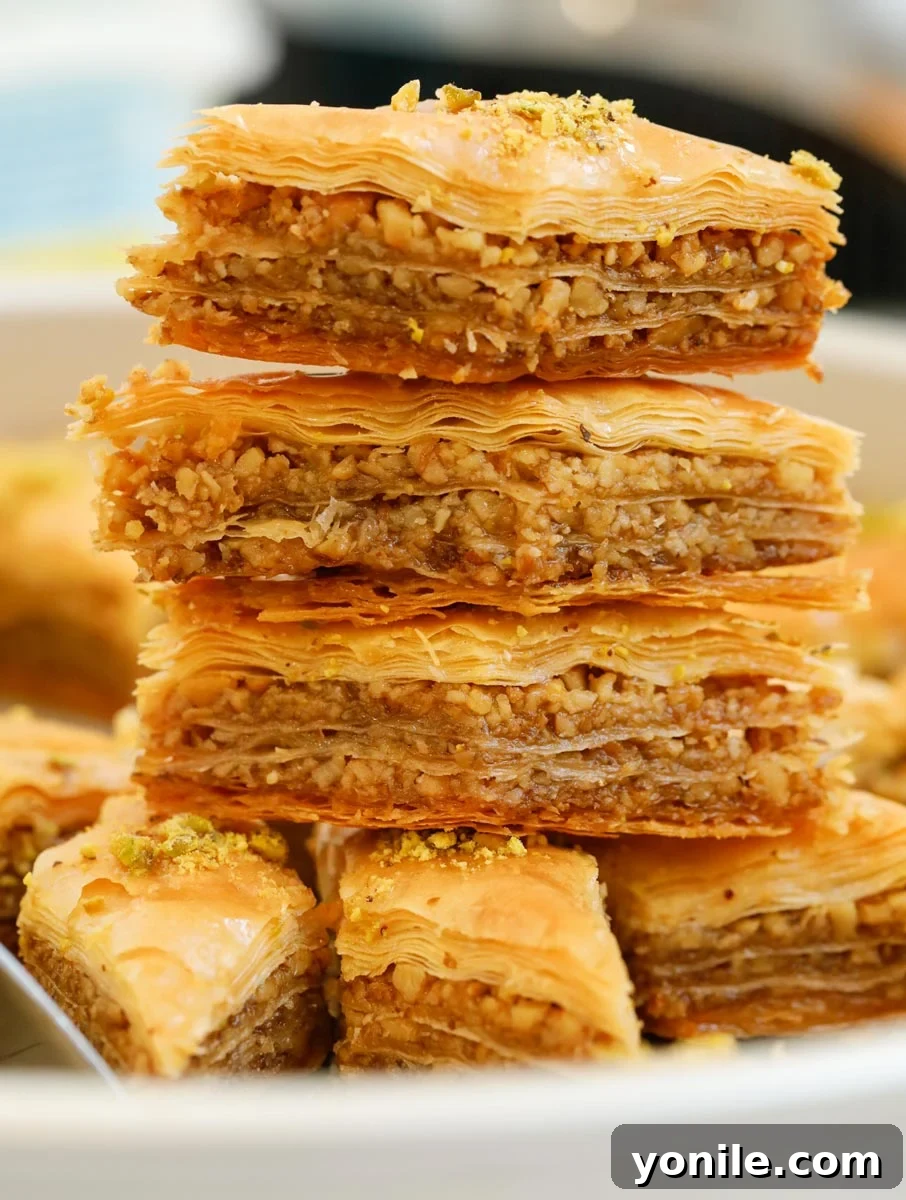
The Art of Layering: Building Your Baklava Masterpiece
The secret to perfect baklava lies in its meticulously layered structure. Here’s a summary of the layering process, ensuring a balanced distribution of crisp phyllo and rich walnut filling. For complete, detailed instructions, please refer to the comprehensive recipe card below.
- Start by generously brushing the bottom of your baking pan with melted ghee.
- Carefully place one phyllo sheet into the pan, then lightly brush its surface with ghee. Repeat this step nine more times, creating a base of ten ghee-brushed phyllo layers.
- Gently press down on these layers to ensure they are compact and free of any trapped air bubbles.
- Evenly spread 1½ cups of the prepared ground walnut filling over the phyllo base.
- Top the walnut layer with five more phyllo sheets, brushing ghee between each sheet.
- Again, press down firmly to create an even, smooth surface, eliminating any air pockets.
- Add another 1½ cups of ground walnut filling, spreading it out evenly.
- Layer with another five ghee-brushed phyllo sheets, following the same brushing technique.
- Press down well to compress the layers.
- Distribute the final 1½ cups of ground walnut filling over this section.
- Finally, place the last ten ghee-brushed phyllo sheets on top, creating a robust upper crust.
- Once all layers are in place, press down very firmly on the entire surface, then give the top layer a final, generous brush with ghee. This ensures ultimate crispness and a golden finish.
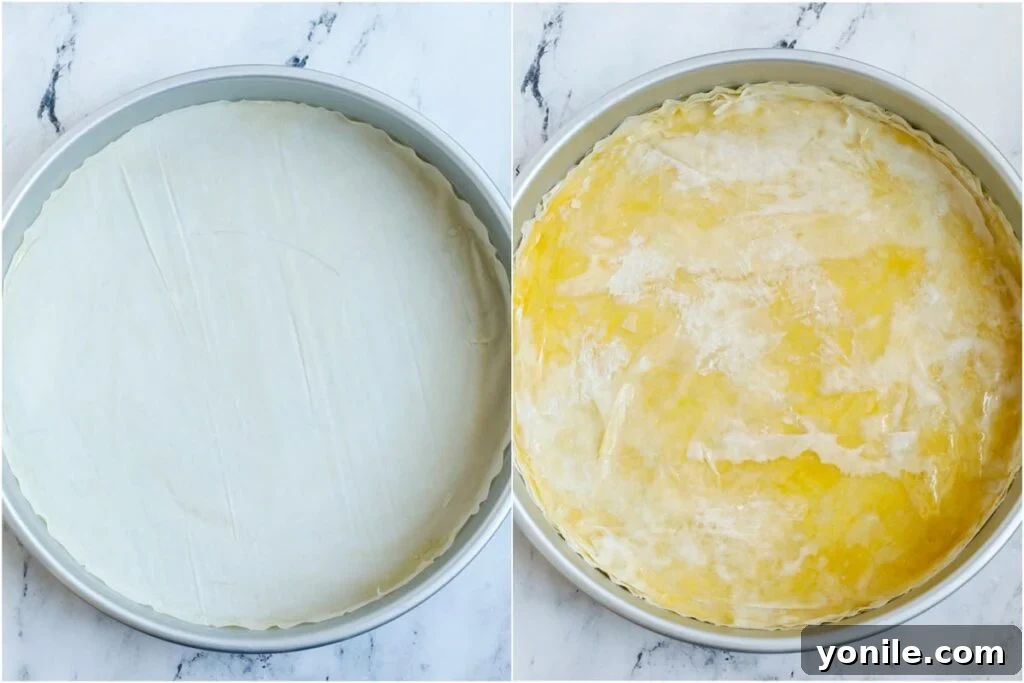
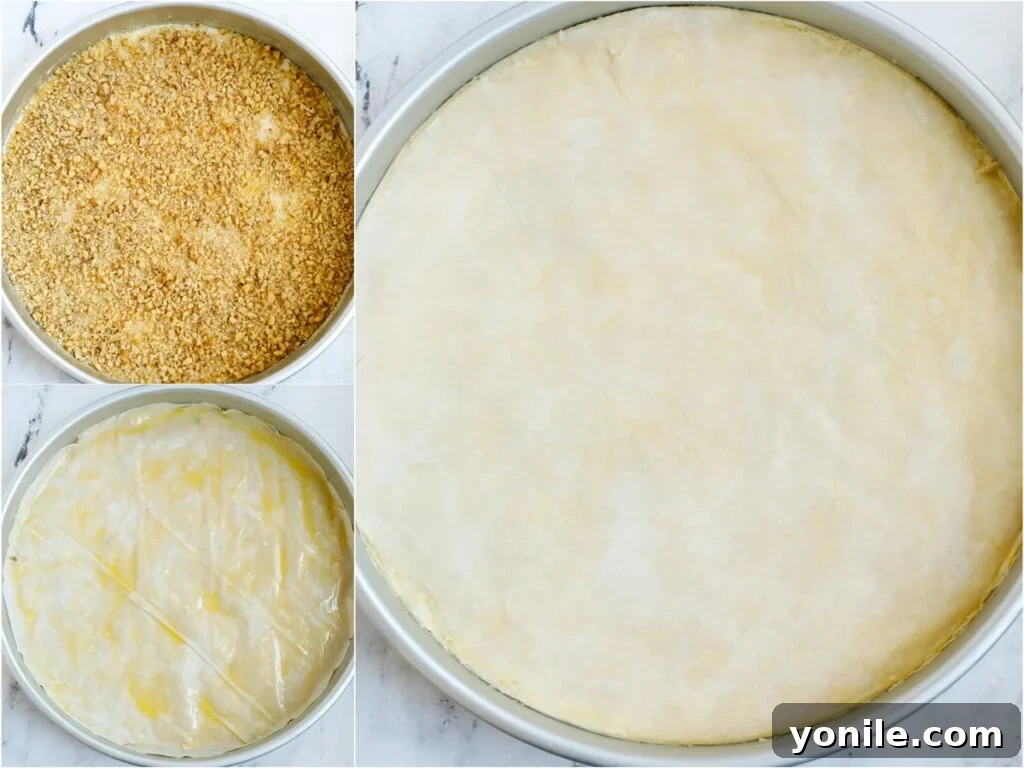
Precision Cutting: Shaping Your Baklava
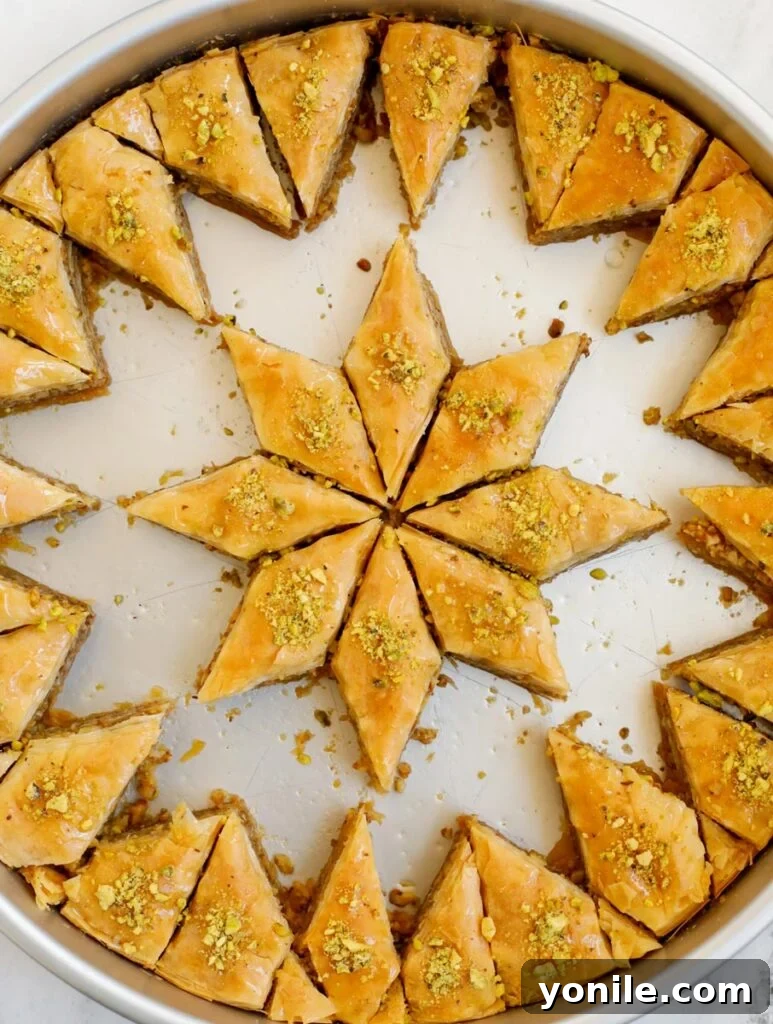
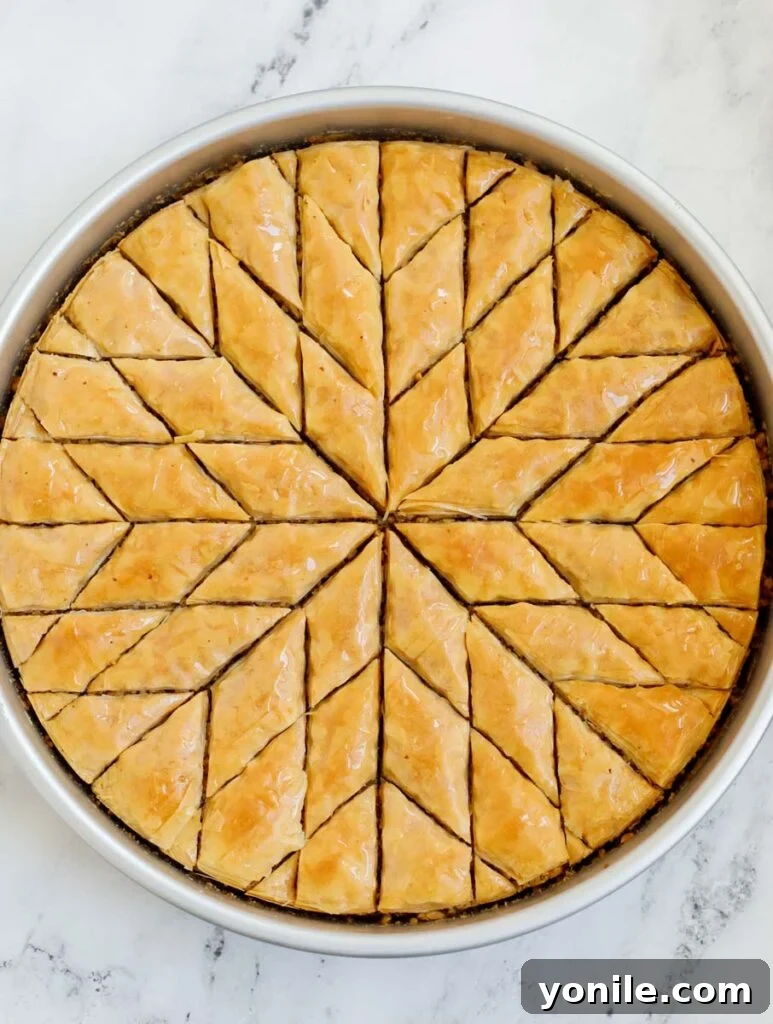
Cutting baklava before baking is a crucial step for achieving perfect, crisp pieces. Here’s how to create the traditional diamond pattern:
- Using a very sharp knife with a pointed tip, carefully cut the entire baklava into four equal triangles.
- Next, divide each of these large triangles in half, resulting in a total of eight equal triangular wedges.
- Working with one wedge at a time, make two straight cuts, approximately 1 inch apart, running parallel to one of the triangle’s straight sides.
- Then, make two more cuts, also 1 inch apart and parallel to the opposite straight side of the same triangle. These intersecting cuts will create the classic diamond pattern within that wedge.
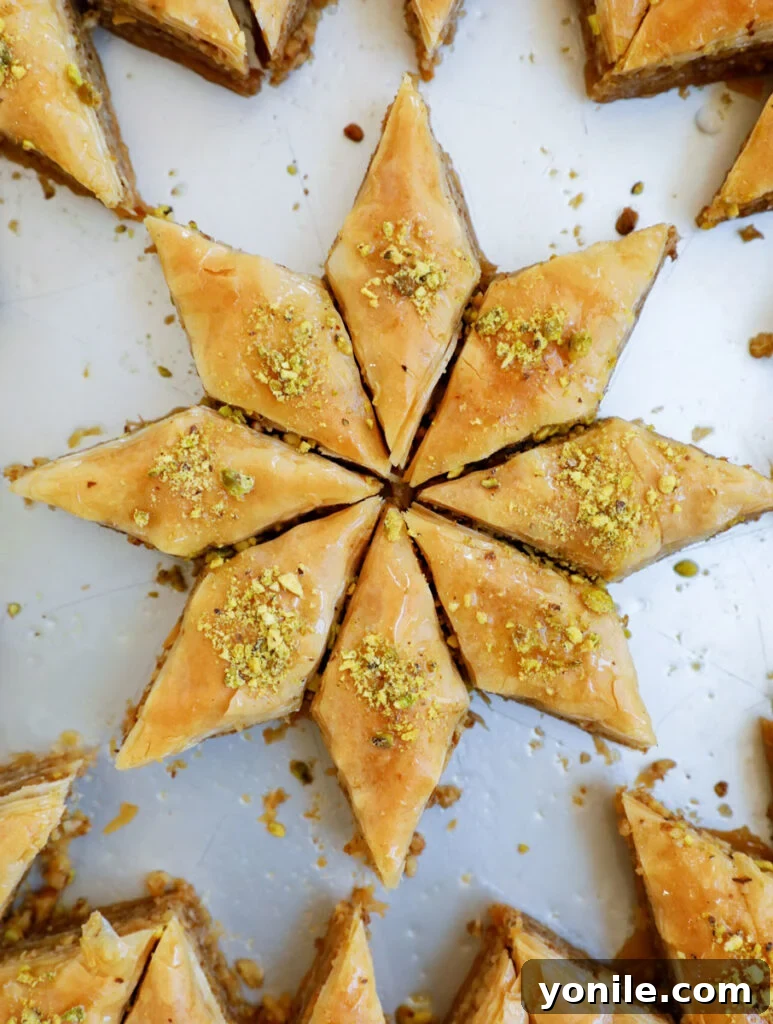
- Repeat this precise cutting process for the remaining seven wedges. This method ensures uniform pieces that bake beautifully and are easy to serve. For a visual guide, refer to the detailed photo reference provided in the blog post.
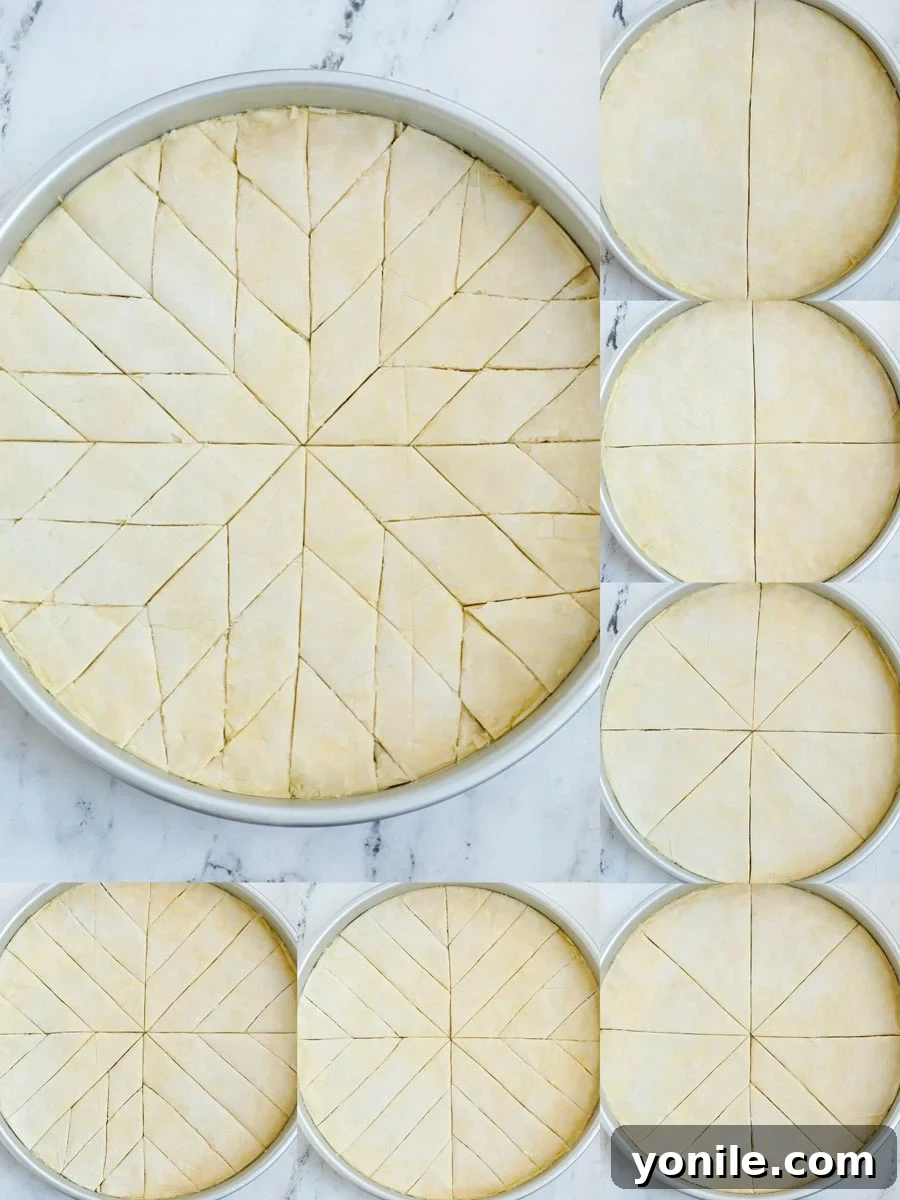
- Bake to Golden Perfection: Place the baklava tray on the middle rack of your preheated oven and bake for approximately 45 minutes. At this point, the edges and the top layers of the baklava should have turned a light golden-brown. If you prefer a deeper golden color, you can briefly activate the top broiler for just 1-2 minutes. However, extreme caution is advised: watch it “very closely” during this stage, as baklava can burn incredibly fast under the broiler. Do not, under any circumstances, take your eyes off it!
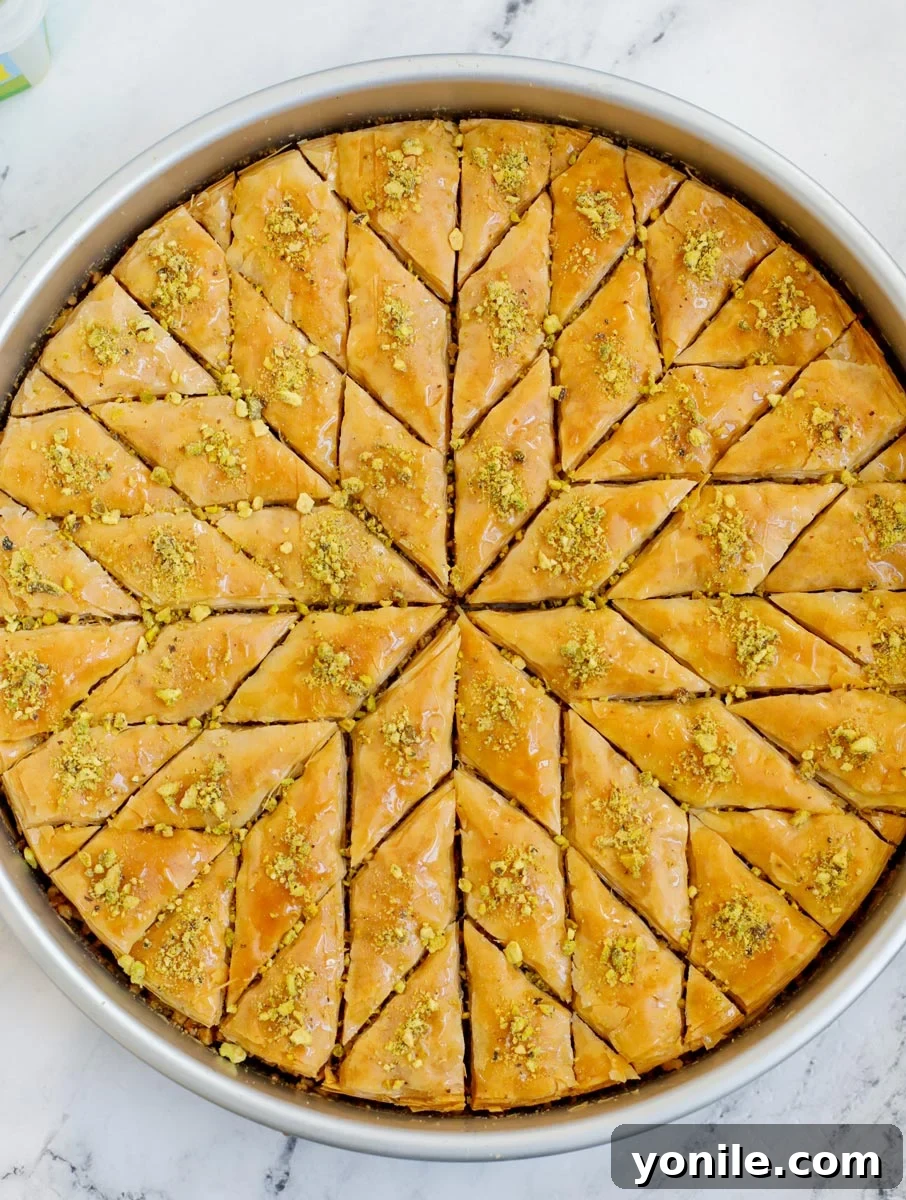
- Syrup Infusion: Immediately upon removing the baklava from the oven, generously drizzle 1¼ cups of the cooled simple syrup evenly over the entire surface. The sizzling sound as the cold syrup meets the hot pastry is a delightful indication that it’s being perfectly absorbed. You can adjust the amount of syrup to your personal preference, but this quantity consistently yields a beautifully moist and sweet baklava. For even distribution, a squeezable bottle works wonderfully for drizzling the syrup.
Expert Tips for Crafting Your Ultimate Baklava
Achieving baklava perfection is a rewarding culinary journey, and these expert tips will guide you to a consistently delicious outcome:
- Proper Phyllo Thawing is Essential: Since phyllo sheets are sold frozen, ensure you thaw them correctly and well in advance. The ideal method is to transfer them from the freezer to the refrigerator overnight. Alternatively, you can thaw them quickly on the countertop at room temperature for a few hours. Crucially, avoid working with partially frozen or damp phyllo, as any excess moisture will make the delicate sheets stick together, tear easily, and become incredibly difficult to handle. Patience here will save you frustration!
- Phyllo Sheet Handling and Pan Size: If you’re using smaller phyllo sheets that don’t perfectly fit your round pan, as mentioned in the preparation steps, you can still achieve a beautiful baklava. Layer and brush the phyllo as instructed, then trim the edges with a sharp knife before adding each walnut layer and the final top layer. Another option is to use a smaller baking tray that matches your phyllo sheet size, but remember to adjust the quantities of walnuts, ghee, and simple syrup accordingly. If the round pattern is too challenging, don’t hesitate to use a rectangular or square tray and cut your baklava into classic squares for an equally delightful result.
- Don’t Fear the Tear: Phyllo dough is famously delicate and prone to tearing. If a sheet rips while you’re working with it, do not fret! Once baked, the layers will meld together, and no one will ever notice a small imperfection. Simply continue layering, and the final product will still be magnificent.
- Keep Phyllo Covered: To prevent the phyllo sheets from drying out and becoming brittle as you work, always keep the stack covered with a lightly damp kitchen towel. Exposure to air can quickly dehydrate them, making them unworkable.
- Syrup Temperature Matters: Always prepare your simple syrup well in advance so it has plenty of time to cool completely to room temperature. Pouring hot syrup over hot baklava will prevent proper absorption, resulting in a soggy rather than perfectly moist and crisp texture. The temperature contrast is key for that satisfying sizzle and ideal infusion.
- Cut Before You Bake: This is a golden rule for baklava! It is absolutely essential to cut your baklava into its desired portions *before* it goes into the oven. After baking, the phyllo layers become incredibly crisp and flaky, making it nearly impossible to slice clean, even pieces without them shattering. Pre-cutting ensures beautiful, defined portions.
- Storage for Longevity: Baklava is a fantastic make-ahead dessert. Store it in an airtight container at room temperature for up to a week to maintain its delightful crispness. While it can also be kept in the fridge, it may lose some of its crisp texture. Rest assured, it’s usually devoured long before it has a chance to dry out!
Frequently Asked Questions About Baklava
Despite both being flaky pastries, puff pastry and phyllo dough are not interchangeable for baklava. Puff pastry relies on steam to dramatically puff up during baking, creating large, airy layers. This characteristic is not ideal for baklava, which requires many thin, crisp, compressed layers for its signature texture. Using puff pastry would result in a very different, and likely unsatisfactory, dessert.
Baklava is indeed a rich dessert, and its calorie content stems from its key ingredients. The generous use of simple syrup, which is essentially concentrated sugar, contributes significantly to its sweetness and caloric value. Additionally, the walnut filling itself is processed with powdered sugar, and melted ghee (clarified butter) is generously brushed between layers. Ghee, being pure fat, is calorie-dense. While it’s a decadent treat, enjoying baklava in moderation allows you to indulge without worry.
While simple syrup is traditional for many baklava recipes, you can certainly use honey as an alternative. Some people prefer the distinct flavor profile that honey provides, offering a richer, more complex sweetness. However, for a truly authentic Lebanese baklava experience, the simple syrup infused with aromatic orange blossom and rose water makes an immense difference in the overall flavor and fragrance.
Absolutely! Baklava is incredibly versatile, and you are welcome to customize the filling with your favorite type of nut or a combination of several. Pistachios are another popular choice, creating a vibrant green baklava. Almonds, pecans, or even a blend of nuts can also yield delicious results, allowing you to experiment and find your perfect flavor combination.
While you can technically use regular butter, ghee is highly recommended for baklava. Ghee is clarified butter, meaning the milk solids and water have been removed, leaving behind pure butterfat. This results in a higher smoke point, a richer nutty flavor, and, crucially, a superior crispness for the phyllo layers compared to regular butter. You can even make ghee from butter by simmering it gently and straining, ensuring you get that authentic, rich finish.
Baklava is an excellent make-ahead dessert! You can prepare it a couple of days before you plan to serve it. Once baked and completely cooled, store it in an airtight container at room temperature. Storing it this way helps maintain its wonderful crispness. While it can be kept in the refrigerator, it might lose some of its delicate crunch. It will stay fresh and delicious for at least a week, though it’s usually enjoyed much sooner!
Yes, baklava freezes beautifully! To freeze, wrap the cooled pieces tightly in plastic wrap, then again in aluminum foil, or place them in an airtight freezer-safe container. It can be stored in the freezer for up to 3 months. For convenience, it’s advisable to freeze baklava in smaller portions, so you can thaw only what you need. Avoid thawing and refreezing multiple times. When you’re ready to enjoy it, simply transfer the desired portion to the refrigerator overnight to thaw.
Explore More Authentic Lebanese Recipes
If you’ve enjoyed the rich flavors of this Walnut Baklava, you’ll love diving deeper into Lebanese cuisine. Here are some more delightful recipes to explore and expand your culinary repertoire:
- Lebanese Spinach Pies (Fatayer Bi Sabanekh): Savory pastries filled with seasoned spinach and lemon.
- Lebanese Chicken Lentil Soup: A hearty and comforting soup, perfect for any season.
- Easy Kafta and Potato Stew: A flavorful and simple stew featuring spiced ground meat and tender potatoes.
- Authentic Baba Ghanouj: A smoky, creamy eggplant dip, a staple of Middle Eastern mezze.
- Homemade Zaatar Manakeesh: Delicious Lebanese flatbreads topped with the fragrant za’atar spice blend.
- Lebanese Meat Pies (Fatayer Blahmeh): Savory pastries filled with seasoned minced meat.
I genuinely hope you find joy and inspiration in all the recipes I share with you, especially this magnificent Walnut Baklava. I encourage you to try it, savor every moment, rate it, and share this culinary gem with your cherished friends and family!
Should you try this recipe and find it to your liking, please consider leaving a star rating and a comment below. Your feedback is invaluable! Also, be sure to follow me at Cookin’ With Mima on FACEBOOK | INSTAGRAM | PINTEREST for all my latest social posts, delicious recipes, and culinary adventures.
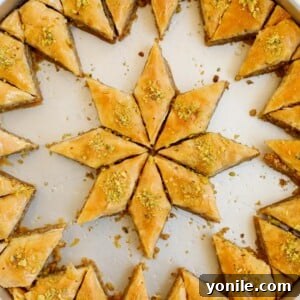
Homemade Baklava With Walnuts
Equipment
-
1 – 13 x 2 inch round aluminum pan
-
Cooking brush
Ingredients
- 2 16 oz. 14 x 18 phyllo sheet packs, or 2 – 9 x 14 16 oz. sheet packs
- 1 cup ghee, melted, preferably grass fed
- 1¼ cup Simple Syrup, More or less to preference
- 2-3 tbsps. ground pistachios, for garnishing
The Filling
- 4 cups whole walnuts, just the normal ones at the store
- ½ cup powdered sugar, or less to preference
Instructions
-
Prepare the simple syrup first and allow it to cool completely. Ensure your ghee is melted and ready for use.
-
Preheat your oven to 350°F (175°C).
-
In a food processor, combine the whole walnuts and powdered sugar. Pulse until the walnuts are finely ground to a coarse texture. Transfer the mixture to a bowl and set aside.
-
Unfold the phyllo sheets onto a large cutting board, smoothing and aligning them evenly. Note: If using smaller phyllo sheets, you may not need to trim them. If your sheets are larger than your pan, place the baking pan on top of the phyllo stack as a guide to cut the sheets to fit. Repeat for the second pack of phyllo sheets. Remember to keep unused phyllo covered with a damp towel to prevent drying.
-
Once your phyllo sheets are prepared, brush the bottom of your baking pan generously with melted ghee. Lay one phyllo sheet into the pan and brush it lightly with ghee. Repeat this process nine more times, creating a base of 10 ghee-brushed phyllo sheets. Evenly spread 1.5 cups of the ground walnut filling over this base.
-
Place another phyllo sheet over the nuts and gently dab with ghee rather than brushing, as vigorous brushing may displace the nuts. Add 4 more sheets, brushing ghee between each one. Before brushing the top of the 5th sheet, gently but firmly press down the surface with your palm to compress the nuts and layers. Then, brush this 5th layer with ghee.
-
Add another 1.5 cups of ground walnuts, then top with 5 more phyllo sheets, brushing between each, just as you did before. For the final walnut layer, add the remaining 1.5 cups of ground walnuts. This time, for the very top, layer with 10 phyllo sheets, similar to the bottom layer. Before the final brushing with ghee, press down the entire surface very well with your palm to ensure all layers are compressed.
-
Using a sharp, pointed knife, cut the baklava into 4 equal large triangles. Then, cut each large triangle in half to form 8 smaller triangles in total. From one wedge, make two straight cuts, about 1 inch apart, parallel to one side of the triangle. Then make two more cuts, parallel to the opposite side of the same triangle, creating a beautiful diamond pattern. Repeat this process for the remaining 7 wedges. Refer to the photos in the blog post for visual guidance.
-
Place the tray on the middle rack of your oven and bake for 45 minutes. At this point, the edges and surface of the baklava should be lightly golden brown. If you prefer a richer golden color, you may turn on the top broiler for just 1-2 minutes. Watch it “very closely” during this time; baklava can burn extremely quickly under the broiler, so do not take your eyes off it!
-
Immediately remove the baklava from the oven and evenly drizzle 1¼ cups of the cooled simple syrup all over the hot baklava. Adjust the amount of syrup to your preference; this quantity provides a perfect balance for us. A squeezable bottle is ideal for spreading the syrup uniformly.
Notes
- Ensure your phyllo sheets are completely thawed ahead of time. They are sold frozen, so either thaw them overnight in the fridge or quickly at room temperature on the counter. Any dampness or residual frost will make the phyllo difficult to work with.
- If using smaller phyllo sheets and unable to achieve a round cut, you can layer and brush the phyllo as instructed, then trim the edges before adding each walnut layer and the final top layer. Alternatively, use a smaller tray to fit the sheets, but adjust the quantities of walnuts, ghee, and simple syrup accordingly. If cutting a round is too challenging, a rectangular or square tray with square cuts is always an option.
- If your phyllo pastry tears, don’t worry. After baking, the layers will fuse, and no one will notice the slight imperfection.
- Keep the phyllo sheets covered with a damp towel as you work to prevent them from drying out and becoming brittle.
- Start preparing your simple syrup early so it has sufficient time to cool. Hot syrup will not be absorbed properly by the hot baklava, leading to a less desirable texture.
- It is crucial to cut the baklava before baking! Once baked, the phyllo sheets become extremely flaky and crisp, making clean, even slices much harder to achieve.
Nutrition
Love this recipe? Rate and comment below!